I call upon You, Lord, God of Abraham and God of Isaac and God of Jacob and Israel, You who are the Father of our Lord Jesus Christ, the God who, through the abundance of your mercy, was well-pleased towards us so that we may know You, who made heaven and earth, who rules over all, You who are the one and the true God, above whom there is no other God; You who, by our Lord Jesus Christ gave us the gift of the Holy Spirit, give to every one who reads this writing to know You, that You alone are God, to be strengthened in You, and to avoid every heretical and godless and impious teaching.

St Irenaeus of Lyons, Against the Heresies 3:6:4


Showing posts with label Confessionalism. Show all posts

Tuesday, June 3, 2014

Robert Shaw on the Value of the Confession


The Westminster Confession of Faith contains a simple exhibition of the truth, based upon the Word of God; but its several propositions are laid in opposition to the heresies and errors which had been disseminated in various ages. It has, therefore, been a prominent object of the author of the Exposition to point out the numerous errors against which the statements in the Confession are directed. The reader will thus find the deliverance of the Westminster of Divines upon the various errors by which the truth has been corrupted in former times, and will be guarded against modern errors, which are generally only a revival of those that had previously disturbed the Church, and that had been long ago refuted.
                 
Robert Shaw, The Reformed Faith: An Exposition of the Westminster Confession of Faith, from the preface.

Monday, January 6, 2014

Lutherans' Consubstantiation: Trampling Under Foot All Reason, Sense, and Understanding

Martin Luther once stated “Faith must trample under foot all reason, sense, and understanding.” He might as well have included biblical truth and sound doctrine in this list. This is precisely what he and his successors did in their formulation of their understanding of Christ’s presence in the Eucharist, the doctrine commonly called consubstantiation.

Lutherans’ confessional commitment to consubstantiation, their view of the Eucharist, must be considered heresy in that it contradicts the orthodox formulation of Christology as prescribed in the Creed of Chalcedon, which reads, “One and the same Christ, Son, Lord, only begotten, to be acknowledged in two natures, inconfusedly...” This clause was in response to the original heresy of Eutyches, which was condemned at the Council of Chalcedon in A.D. 451.

How, though, does the Lutheran confessional stance on the Eucharist confuse Christ’s two natures?

The Epitome, one of the central Lutheran confessional documents, contains a blatant contradiction, which leads to the contradicting of the Chalcedonian Christology. In chapter eight, “The Person of Christ,” the Epitome affirms the following.

VIII. The Person of Christ: Affirmative Theses

[6] 2. We believe, teach, and confess that the divine and human natures are not mingled into one substance, nor the one changed into the other, but that each retains its own essential properties, which [can] never become the properties of the other nature.

[7] 3. The properties of the divine nature are: to be almighty, eternal, infinite (that is, boundless and without spatial limitation [KS]), and to be, according to the property of its nature and its natural essence, of itself, everywhere present, to know everything, etc.; which never become properties of the human nature.

[8] 4. The properties of the human nature are: to be a corporeal creature, to be flesh and blood, to be finite and circumscribed, to suffer, to die, to ascend and descend, to move from one place to another, to suffer hunger, thirst, cold, heat, and the like; which never become properties of the divine nature.

Here are some clear points that may be adduced from these theses.

1. The divine and human natures do not comingle; each nature retains its own properties, which are never communicated to the other nature (from [6]2).

2.  Omnipresence and infinity are properties of the divine nature, and never become properties of the human nature (from [7]3).

3. Flesh and blood and finitude are properties of the human nature (from [8]4).

These are some of the most basic doctrines of Christology and are worthy of full acknowledgement and confession by any claiming to be faithful Christians. So, from these three general propositions, one can make the following synthesis.

C1. The flesh and blood of Christ (human nature) can never possess the properties of omnipresence and infinity (of the divine nature, being “everywhere present”).

This seems to be a necessary implication of the three theses from the Epitome, chapter 8, on the Person of Christ. This then is a foundational belief for a faithful Christology, according to both the Chalcedonian Creed and the Epitome-Concord; and, I’d argue, the scriptures. Concluding this, we have a good starting point to go back one chapter in the Epitome, chapter 7, and consider its theses on the Eucharist.

For clarity’s sake, I’ll use just a few theses from the Negativa, namely [32]11—[34]13. First, though, I’ll include this section’s prefatory remarks. The preface reads,

[21] On the other hand, we unanimously reject and condemn all the following erroneous articles, which are opposed and contrary to the doctrine presented above, the simple faith, and the [pure] confession concerning the Lord's Supper...

The following articles read as follow.

[32] 11. That the body of Christ is so enclosed in heaven that it can in no way be at once and at one time in many or all places upon earth where His Holy Supper is celebrated.

[33] 12. That Christ has not promised, neither could have effected, the essential presence of His body and blood in the Holy Supper, because the nature and property of His assumed human nature cannot suffer nor permit it.

[34] 13. That God, according to [even by] all His omnipotence (which is dreadful to hear), is not able to cause His body to be essentially present in more than one place at one time.

Of course, as part of the Negativa, these theses, as the preface makes clear, are those that are denied by Lutherans. Again, a positive statement of synthesis necessarily follows from the above theses.

C2. The body (i.e., flesh and blood; human nature) of Christ can be omnipresent, “at one time in many or all places upon the earth” (divine nature).

Now, let’s put these two propositions together, one a conclusion from chapter 8 and the other a conclusion from chapter 7, and see if they can be maintained in any sort of meaningful relationship.

C1. The flesh and blood of Christ (human nature) can never possess the properties of omnipresence and infinity (of the divine nature, being “everywhere present”).

And,

C2. The flesh and blood of Christ (human nature) can be omnipresent, everywhere present (divine nature).

Coming now to these two conclusions, which I believe are very fair inferences from the Epitome’s theses, there are only a couple of options available to us.

Option 1. We allow the more basic, foundational doctrine of Christology (C1) to cause us to reevaluate and reformulate as necessary the doctrine of the Eucharist (C2). Granting that we are over 500 years removed from formulation and confession of the formula of the doctrine of the Eucharist, this doesn’t seem likely.

Option 2. We maintain the two doctrines of the Concord stand in clear contradiction. If we were to try to synthesize C1 and C2, it would look something like this.

C3. It is the case that Christ’s human nature cannot possess the divine property of omnipresence; and, it is also that case that Christ’s human nature can possess the divine property of omnipresence.  

This is a particular violation of the general statement of the law of non-contradiction, a most basic law of logic: Something cannot be both A and not-A at the same time in the same sense. Or, to put it in our context: Christ’s human nature cannot be both omnipresent and not-omnipresent. However, that is what I understand, as illustrated above, the Formula of Concord to be saying. This is utter nonsense!

To invoke the miraculous nature of the Supper doesn’t help resolve this. In fact, I don’t question for one second the supernatural or miraculous nature of the Supper; it is nothing less! What I have trouble with, in fact must reject, is the idea that Christ’s institution would entail such a brazen contradiction as this does.

To be clear, I am not promoting rationalism. I don’t understand logic to be something extraneous to the Godhead, to which he is subject. Rather, logic is an expression of the divine nature itself, which was “declared” (exēgeomaito) to us in the incarnation of the Word, the eternal Logos (Jn. 1:18). Being part of the essential nature of God, he cannot contradict himself, or as St. Paul put it, “he abideth faithful: he cannot deny himself,” thus, “he cannot lie” (2 Tim. 2:13; Tit. 1:2). And being created in his image, to reflect his glory, we also cannot violate logic, especially in our thoughts concerning his nature and this holy Supper, wherein he is present.

In chapter 8 of the Epitome, [13]5 of the Affirmative Theses rightly states, “That God's Word is not false, and does not deceive.” Elsewhere, the Formula confidently states that the doctrine of the Eucharist is based solely on the words of Christ, “according to the letter,” and the literal sense. However, if, as I’ve shown above, this doctrine entails a contradiction, then it is false by definition, not to mention deceptive. Moreover, if these doctrines are assuredly good and necessary deductions from the clear teaching of Scripture, then Scripture too must contain at least one contradiction, which would have obvious implications for our bibliology, namely the doctrines of infallibility and inerrancy.

The good Dr. Luther, in spite of the huge debt of gratitude all Protestants owe him, and the mighty ways that God used him and his brilliant mind to contribute to the Reformation, saving the church from her Babylonian Captivity to Rome,  risks being condemned by his own words, when it comes to the doctrine of the Eucharist.

“You conduct yourself like one drunk or asleep, belching out between your snores, ‘Yes, No.’” –Martin Luther (The Bondage of the Will, Vol. 33 of Luther's Works, pp. 113).


Saturday, December 28, 2013

WHY THE NEED FOR CREEDS - PART 4


The No-Creed View Can Make Dictators of Pastors

As mentioned above, the anti-creed attitude reflects the spirit of the age, which is dead set against authorities and historical tradition.

However, not having a public creed, which sets the bounds for the essentials of the Faith, then anything goes for the pastor. A popular response might be, “No! Our pastor only preaches the Bible!” The fact is that, their pastor preaches what his personal understanding of what the Bible means.

So, if a church has “No book/creed but the Bible!” and the pastor is the best trained person to interpret the Bible, then what the pastor says the Bible means will be the most authoritative voice in that church. Without a creed, the members of the church have nothing against which they can check whether what their pastor is saying is true or not.

Taken to its logical end, without a public creed, the pastor is the ultimate authority!

If the pastor best knows what the Bible teaches, and there arises a question of doctrine or life, then what the pastor says is the last word on the issue. On the flip side, if a church has a public creed and confession, the other elders or even members of the church have a standard or rule by which they can test the teaching.

In I John 4:1, the apostle John says, “Beloved, do not believe every spirit, but test the spirits (i.e., teachings, messages) to see whether they are from God, for many false prophets have gone out into the world” (ESV).

In the very next verse (v. 2), the Apostle then goes on to give the standard by which the teachings are to be evaluated. In this, he gives us a creed, a confession!! “By this you know the Spirit of God: every spirit that confesses that Jesus Christ has come in the flesh is from God” (ESV). This statement functioned as a creed, over against the group in the church known as the Gnostics, which denied that the man Jesus was the Christ. Rather, they taught that the Christ was pure spirit that used the mere human Jesus of Nazareth as a sort of vehicle, as he cruised around teaching those in the know how to escape earthly reality. The Apostle teaches us to reject Gnosticism, since it contradicts our confession of Christ, “conceived by the Holy Spirit, born of the virgin Mary...etc.,” that is, Christ’s incarnation.

So, just like the apostle John prescribed, public creeds function to test the claims of those who are responsible to teach and rule in the church. 


Wrapping It Up

Despite how popular the sloganeering claims of “No creed but...” are in today’s church culture, they are something that may work on a bumper sticker, but cannot stand against logic, the Bible, church history. This attitude also creates dysfunction in the life of the church.

In summary:

            1. “No creed but...” is self-refuting, because “No creed...” is a creed!

2. “No book but the Bible” is a claim that is against the teaching of the Bible, because the Bible is full of creeds and teaches us to maintain them.

3. The fact is that, everyone has a creed, whether it is public or private!

4. The private-creed view can lead to the pastor becoming a dictator, since there is no standard by which to test the pastor’s interpretation of the Bible.

How good is God, that he has graciously worked the thought, circumstances, theology and history of his church to hand down to us—and future generations—the ancient creeds, confessions, and catechisms, which have shaped who we are and remind us of our rich and deep heritage, going back to Christ’s apostles! Let us pray that as he nurtures our appreciation and use of the creeds, he likewise give us the grace to help lead the church in a faithful trip back to the future, and in her seeing the need for creeds!

Friday, December 27, 2013

Why the Need for Creeds - Pt. 3


FACT: Everyone Has a Creed! 

The question is not whether this church or that church has a creed/confession or not. Rather, the real question is this:

“Is this or that church’s creed/confession public or private?”

This is really the only question, because every church, in fact nearly every social group, will have a certain set of core or fundamental convictions and values that bind the members together, and which defines what it means to be a member. Those values and beliefs that unify and have authority over a particular group serve as that groups “constitution” or better “creed/confession.”

Imagine if everyone took their anti-creed attitude to the streets! Imagine further how SCARY it would be if every driver you met on the road had the same attitude, saying,

I’m a free spirit! I’m not going to have any set of so-called “safe driving” conventions and principles determine my driving habits! No! How, when, and at what speed I drive my car is my personal business! “Drive on the right hand side,” they say?!? Ha! I’ll show them; I’ll take my half-out of the middle!  Heck, why should I have to share the road at all?!?

To look at it another way, think about sports. What if at the next Super Bowl, all the team members and coaches got together and decided,

Enough of this smothering “tradition”!! We’ll never be the best players we can be, if we keep playing according to the traditional understanding of what “football” means! If we don’t break loose—in this very game—then the sport will never progress, never move forward.

It’s always been the same! Tradition has forced us into believing that football is “a game played between two teams of 11 players each in which the ball is in possession of one side at a time and is advanced by running or passing.” No more!! Today, we are going on that field and redefining what football means!  We’ll put out all our players...or maybe just five. I say we dribble instead of carry the ball. Boys, if we throw off the old tradition of what football is and means, anything is possible!!!

That right! And, if anything is possible, then nothing is possible. If the driving example were true, no one would have the guts to drive anywhere; it would be like a war zone! What if the football example were the case? One thing is sure, whatever they’d be doing out there, hoping to make football some greater thing, it would no longer be football at all!!!

Thankfully, whether in driving or sports, people don’t try to apply their anti-creed attitude most of the time. And, thankfully, despite their anti-creed slogans, no one pretends to reinvent Christianity or the meaning of the Bible each and every Sunday! That is because everyone has a creed/confession that governs their understanding of what it means to be worshipping as Christians and what the Bible teaches on all the major points of doctrine.

Do anti-creed churches reinvent what Christianity means each Sunday? No! Why not, though?

Because in reality they have a creed; it’s a private creed rather than a public one. But, what’s the problem with a creed being private? There are a couple of real problems with the private creed approach.

(1) If a church’s creed is private, then it can change without notice. This leads to distrust, uncertainty, and confusion in a church.

(2) If a church’s creed is private, then it can never be challenged, because it isn’t explicitly known. 

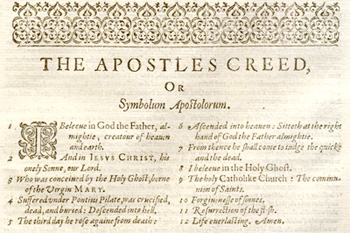
Whether it is the Apostles’ Creed, which has been around for almost 1700 years, or it’s the Heidelberg Catechism, which has been around for over 450 years, these creeds have had a long career and have served the church through her history. Being some of the most widely known and confessed documents in the world, they have also been scrutinized and picked-over for centuries, and have withstood the challenges of critics, skeptics, and other opponents. So, despite all the challenges our public creeds have suffered, today with the church all around the world, we still confess, “Credo,” “I BELIEVE ...etc.”