Showing posts with label Worship. Show all posts
Showing posts with label Worship. Show all posts
Saturday, May 10, 2014
PRACTICAL REASONS FOR RETAINING THE KJV, DR. JOEL BEEKE
1. The Standard Text of the English Bible
It is wiser to choose the known over against the unknown. The weaknesses and disadvantages of a particular version of the Bible cannot really be assessed apart from a thorough trial of daily usage over many years. Many who welcomed the New International Version (NIV) with great enthusiasm when it first appeared are now prepared to admit its serious weaknesses as a translation.
The KJV is well established in the market-place and in the literature of Christian scholarship. It will continue in production in many editions for years to come. Helps and reference works are commonly available. It is not likely that the KJV will fade from view and disappear as have many versions produced to supplant it.
Likewise the KJV is widely studied and commented on in the literature of biblical scholarship. It will always be a standard of reference and comparison of Bible commentators. All other versions are compared to it, contrasted with it, tested by it. Campaigns to sell other versions must attack it. The same cannot be said of any other Bible version.
2. Based on the Full Text of the Hebrew and Greek Originals
Based on the Textus Receptus (the Greek NT), and the Masoretic Text (Hebrew OT), the KJV gives the most authentic and fullest available text of the Scriptures, with none of the many omissions and textual rewrites of the modern translations such as the Revised Standard Versions (RSV) and the NIV.
(a) Oldest Does Not Mean Best – The Westcott and Hort arguments that ‘the oldest manuscripts are the most reliable’ and that ‘age carries more weight than volume’ are not necessarily true. It could well be that the two oldest, complete manuscripts were found to be in such unusually excellent condition because they were already recognized as faulty manuscripts in their time and therefore were placed aside and not recopied until worn out as were the reliable manuscripts. This is further supported by numerous existing differences between the Vatican and Sinaitic manuscripts.
(b) Volume – The King James Version is based upon the Traditional Text. The vast majority of the more than 5,000 known partial and complete Greek manuscripts follow this textual reading.
(c) Church History – The ‘Received’ or ‘Ecclesiastical’ Text has been used by the church historically. The English, French, Dutch, and German Reformation churches all used Bibles based on the Traditional Text. (The Dutch ‘Statenvertaling’ is also based upon the ‘Ecclesiastic’ Text.)
3. A More Faithful Method of Translation
The KJV translators employed a method of verbal equivalence (‘word for word’) rather than the method of paraphrase of dynamic equivalence (‘meaning for meaning’) used in the NIV. The result is that the KJV gives you what biblical authors wrote, not what a committee thinks they meant to write.
4. A More Honest Translation
The text of the KJV used italics to identify every word or phrase interpolated (supplied by the translator) and not given in the original. Such a practice was not followed in the NIV, lest the loose method of its translators be unmercifully exposed to view.
5. A More Precise Idiom
Often attacked at this very point, the KJV actually is a more accurate and helpful translation precisely because of the archaic pronouns (‘thou, thy, thee,’ etc.). Both Hebrew and Greek distinguish clearly between the 2nd person singular (‘thou’) and the 2nd person plural (‘ye,you’). In many statements this makes an important difference (e.g. John 3:7). In a sense it is correct to say that in praying the Lord Jesus used ‘Thou’ – God is one, not many! – for he definitely used the Hebrew or Greek equivalent.
6. The Best Liturgical Text
The KJV excels as a version to be used in public worship. That is why it has been used so widely in the churches. The requirements of the sanctuary are not those of the classroom. Other versions may be helpful on occasions to the student, but none is more edifying to the worshipper.
7. The Best Format For Preaching
The KJV traditionally has been laid out verse by verse on the page, rather than in paragraphs; though for most of the text, paragraphs are indicated by a sign. The Hebrew and Greek texts, of course, have no paragraphing at all. The verse-by-verse format best serves the purpose of verse-by-verse consecutive expository sermonizing.
8. The Most Beautiful Translation
The KJV gives classic expression to many important passages in the Bible (e.g. Ps 23, Isa 53, Luke 2, and the Parable of the Prodigal Son). Our seniors need to hear these passages as a comfort and help as they draw near to the end of life’s journey and our children need to hear them in the KJV as part of their nurture and education. They need to understand that the KJV is an important part of the spiritual and cultural heritage of all English-speaking Christians, and a key to our greatest literature. Children well instructed in the KJV will be greatly advantaged over other children, spiritually, linguistically, educationally, and culturally.
9. An Ecumenical Text For Reformed Christians
No other version has been used so widely among evangelical Christians. More significantly for Reformed Christians, this version is used by preference in many conservative Reformed congregations. The KJV is also used in the Christian schools these churches sponsor. Using the KJV is one way to underscore our unity and identity with other conservative evangelical and Reformed Christians.
10. A Practical Choice
The KJV is available in many editions; with a full range of helps and reference materials, not to mention computer software; in large-type, clear-print editions; and often priced well below modern translations.
11. ‘Sounds’ Like the Bible
More than any other version, the KJV sounds like the Word of God, even to unbelievers. The KJV translators aimed at this very thing. Even in 1611 the KJV sounded old-fashioned, ancient, a voice from the past. This was to command a reverent hearing, and to suggest the timeless and eternal character of God’s Word.
The modern unbeliever, if he has any spiritual concern at all, is well aware that the contemporary scene really offers him no hope. He expects the church to speak in a way that is timeless and other-worldly.
Many church-goers and occasional visitors to a church go much more by ‘feel’ and ‘mood’ than by intellectual content or apprehension. They are more likely to take seriously what is said to them if they sense that this is something more important than a casual conversation.
12. The Character of the Translators
The fifty men appointed to translate the King James Version were not only well-known scholars, but were also men of sound religious faith. They were strong believers in every word of the Bible being inspired by God and in all the central doctrinal truths of Scripture. They were God-fearing men whose lives testified of a saving knowledge of these truths. This same testimony cannot be made of all translators serving on modern translation teams.
13. Upholds ‘Old Paths’
Using the KJV is a clear statement of where we stand and want to be as a church walking in the ‘old paths’ of God’s Word. ‘Thus saith the LORD, Stand ye in the ways, and see, and ask for the old paths, where is the good way, and walk therein, and ye shall find rest for your souls’ (Jer 6:16). In choosing this version we choose to stand with all that is best in the great tradition of historic Christianity.
The penchant for new translations was part of the program of change which has done such harm to many denominations over the past century. This change to new translations was often part of an effort to strip worship services of dignity, reverence, and beauty, in favour of the casual, the contemporary, and the convenient. It also causes a congregation to lose touch with keeping the Word in memory. Memorization of the Scriptures suffers when each generation uses a different translation.
Dr. Joel R. Beeke is the president and professor of Systematic Theology and Homiletics at Puritan Reformed Theological Seminary, and pastor of the Heritage Netherlands Reformed Congregation of Grand Rapids, Michigan.
Thanks to Pooyan Mehrshahi, the Young Puritan, for the repost.

Saturday, January 18, 2014
Co-Dependency is Not the Problem
The other afternoon Fanny and I were standing in the kitchen discussing the concept of "co-dependency." Now, it may be granted that certain folks find too much significance and comfort in a relationship with this or that person. However, I don't think a self-conscious, Christ-conscious Christian should use the popular psycho-babble term co-dependency to describe this situation.
Rather, we've had the correct diagnosis for centuries in Scripture; it is called idolatry. It is elevating another mere mortal to a deified status, and making them to bear the burden of trying to live as your God. We don't need some wacked Freudian analysis or Banduran social theory to explain this. The root of this problematic behavior is that a person isn't co-dependent on the right One; the idolatrous relationship isn’t co-dependency, it's rooted in a failure in being co-dependent on Christ.
However, popular psychology has vilified the concept of co-dependency. This "weakness" is the strength, the muscles and sinews, of the Church! Turning the concept of co-dependency into a "disorder," a "condition," or worse a "disease" (as though behavior is subject to pathology--pleeeez!), or any other term of derision was made easy by our culture's crass individualistic tendencies. Anyone who doesn't wish to be "an island to herself" is thought to be "co-dependent." So, the church is counter-cultural by default, in so far as she is heeding Christ's command to be "co-dependent" upon him and one another.
I don't think one would risk being impious to say that the Trinity is nothing short of the Ultimate Co-Dependency. No one Person could be what he is in isolation from the other two. In fact, most historic heresies have ultimately been instances of attempted theo-therapeutic philosophies, which have sought to "heal" God's co-dependency within himself.
St. Paul said, "Your life is hid with Christ in God" (Col. 3:3). If a person has a problem with being co-dependent, then, well...I suppose there are other religions out there.
Friday, December 27, 2013
Why the Need for Creeds - Pt. 3
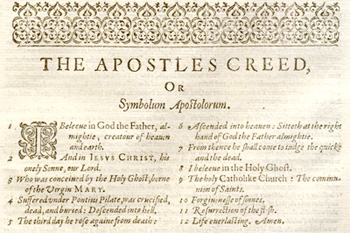
FACT: Everyone Has a Creed!
The question is not whether this church or that church has a creed/confession or not. Rather, the real question is this:
“Is this or that church’s
creed/confession public or private?”
This
is really the only question, because every church, in fact nearly every social
group, will have a certain set of core or fundamental convictions and values
that bind the members together, and which defines what it means to be a member.
Those values and beliefs that unify and have authority over a particular group
serve as that groups “constitution” or better “creed/confession.”
Imagine
if everyone took their anti-creed attitude to the streets! Imagine further how
SCARY it would be if every driver you met on the road had the same attitude,
saying,
I’m
a free spirit! I’m not going to have any set of so-called “safe driving”
conventions and principles determine my driving habits! No! How, when, and at
what speed I drive my car is my personal business! “Drive on the right hand
side,” they say?!? Ha! I’ll show them; I’ll take my half-out of the
middle! Heck, why should I have to share
the road at all?!?
To
look at it another way, think about sports. What if at the next Super Bowl, all
the team members and coaches got together and decided,
Enough
of this smothering “tradition”!! We’ll never be the best players we can be, if
we keep playing according to the traditional understanding of what “football”
means! If we don’t break loose—in this very game—then the sport will never
progress, never move forward.
It’s
always been the same! Tradition has forced us into believing that football is
“a game played between two teams of 11 players each in which the ball is in
possession of one side at a time and is advanced by running or passing.” No
more!! Today, we are going on that field and redefining what football
means! We’ll put out all our
players...or maybe just five. I say we dribble instead of carry the ball. Boys,
if we throw off the old tradition of what football is and means, anything is
possible!!!
That
right! And, if anything is possible, then nothing is possible. If the driving
example were true, no one would have the guts to drive anywhere; it would be
like a war zone! What if the football example were the case? One thing is sure,
whatever they’d be doing out there, hoping to make football some greater thing,
it would no longer be football at all!!!
Thankfully,
whether in driving or sports, people don’t try to apply their anti-creed
attitude most of the time. And, thankfully, despite their anti-creed slogans,
no one pretends to reinvent Christianity
or the meaning of the Bible each and every Sunday! That is because everyone has
a creed/confession that governs their understanding of what it means to be
worshipping as Christians and what the Bible teaches on all the major points of
doctrine.
Do
anti-creed churches reinvent what Christianity means each Sunday? No! Why not,
though?
Because
in reality they have a creed; it’s a private creed rather than a public one. But,
what’s the problem with a creed being private? There are a couple of real problems with
the private creed approach.
(1) If a church’s creed is private, then
it can change without notice. This leads to distrust, uncertainty, and
confusion in a church.
(2)
If a church’s creed is private, then it can never be challenged, because it
isn’t explicitly known.
Whether
it is the Apostles’ Creed, which has been around for almost 1700 years, or it’s
the Heidelberg Catechism, which has been around for over 450 years, these
creeds have had a long career and have served the church through her history.
Being some of the most widely known and confessed documents in the world, they
have also been scrutinized and picked-over for centuries, and have withstood
the challenges of critics, skeptics, and other opponents. So, despite all the
challenges our public creeds have suffered, today with the church all around
the world, we still confess, “Credo,”
“I BELIEVE ...etc.”
Wednesday, May 22, 2013
The Case for Reciting Creeds in Worship with Albert Aymer
[Albert] Aymer has a message for churches doing all they can
to make worship relevant and contemporary. “Remember that worship transcends
time and space,” he urges.
One of the best ways to do that is to use creeds in worship. Continue
reading at the Calvin Institute of Christian Worship.
Subscribe to:
Posts (Atom)