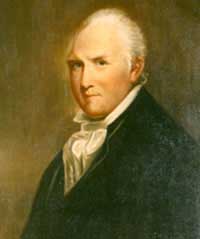
 Please read today’s
post on Rev. John Mitchell Mason, which beautifully reveals racism trounced
at the Table!
Please read today’s
post on Rev. John Mitchell Mason, which beautifully reveals racism trounced
at the Table!
Showing posts with label Lord's Supper. Show all posts
Showing posts with label Lord's Supper. Show all posts
Thursday, March 20, 2014
March 19: This Day in Presbyterian History
Please read today’s
post on Rev. John Mitchell Mason, which beautifully reveals racism trounced
at the Table! 
Monday, January 6, 2014
Lutherans' Consubstantiation: Trampling Under Foot All Reason, Sense, and Understanding
Martin Luther once stated “Faith must trample under foot all reason, sense, and understanding.”
He might as well have included biblical truth and sound doctrine in this list. This is precisely what he and his successors did in their formulation of their
understanding of Christ’s presence in the Eucharist, the doctrine commonly
called consubstantiation.
Lutherans’ confessional commitment to consubstantiation,
their view of the Eucharist, must be considered heresy in that it contradicts
the orthodox formulation of Christology as prescribed in the Creed of
Chalcedon, which reads, “One and the same Christ, Son, Lord, only begotten, to
be acknowledged in two natures, inconfusedly...” This clause was in
response to the original heresy of Eutyches, which was condemned at the Council
of Chalcedon in A.D. 451.
How, though, does the Lutheran confessional stance on the
Eucharist confuse Christ’s two natures?
The Epitome, one of the central Lutheran confessional
documents, contains a blatant contradiction, which leads to the contradicting
of the Chalcedonian Christology. In chapter eight, “The Person of Christ,” the
Epitome affirms the following.
VIII. The Person of
Christ: Affirmative Theses
 [6] 2. We believe, teach, and
confess that the divine and human natures are not mingled into
one substance, nor the one changed into the other, but that each retains
its own essential properties, which [can] never become the properties of the
other nature.
[6] 2. We believe, teach, and
confess that the divine and human natures are not mingled into
one substance, nor the one changed into the other, but that each retains
its own essential properties, which [can] never become the properties of the
other nature.
[7] 3. The properties of the
divine nature are: to be almighty, eternal, infinite (that
is, boundless and without spatial limitation [KS]), and to be, according
to the property of its nature and its natural essence, of itself, everywhere
present, to know everything, etc.; which never become properties
of the human nature.
[8] 4. The properties of the
human nature are: to be a corporeal creature, to be
flesh and blood, to be finite and circumscribed,
to suffer, to die, to ascend and descend, to move from one place to
another, to suffer hunger, thirst, cold, heat, and the like; which
never become properties of the divine nature.
Here are some clear points that may be adduced from these
theses.
1. The divine and human natures do
not comingle; each nature retains its own properties, which are never
communicated to the other nature (from [6]2).
2. Omnipresence and infinity
are properties of the divine nature, and never become properties of the human
nature (from [7]3).
3. Flesh and blood and finitude are
properties of the human nature (from [8]4).
These are some of the most basic doctrines of Christology
and are worthy of full acknowledgement and confession by any claiming to be
faithful Christians. So, from these three general propositions, one can make
the following synthesis.
C1. The flesh and
blood of Christ (human nature) can never possess the properties of omnipresence
and infinity (of the divine nature, being “everywhere present”).
This seems to be a necessary implication of the three theses
from the Epitome, chapter 8, on the Person of Christ. This then is a
foundational belief for a faithful Christology, according to both the
Chalcedonian Creed and the Epitome-Concord; and, I’d argue, the scriptures.
Concluding this, we have a good starting point to go back one chapter in the
Epitome, chapter 7, and consider its theses on the Eucharist.
For clarity’s sake, I’ll use just a few theses from the
Negativa, namely [32]11—[34]13. First, though, I’ll include this section’s
prefatory remarks. The preface reads,
[21] On the other hand, we
unanimously reject and condemn all the following erroneous articles, which
are opposed and contrary to the doctrine presented above, the simple faith, and
the [pure] confession concerning the Lord's Supper...
The following articles read as follow.
[32] 11. That the body of
Christ is so enclosed in heaven that it can in no way be at once and at one
time in many or all places upon earth where His Holy Supper is
celebrated.
[33] 12. That Christ has not
promised, neither could have effected, the essential presence of His body
and blood in the Holy Supper, because the nature and property of His assumed
human nature cannot suffer nor permit it.
[34] 13. That God, according to
[even by] all His omnipotence (which is dreadful to hear), is not able to
cause His body to be essentially present in more than one place at one time.
Of course, as part of the Negativa, these theses, as the
preface makes clear, are those that are denied by Lutherans. Again, a positive
statement of synthesis necessarily follows from the above theses.
C2. The body (i.e., flesh and
blood; human nature) of Christ can be omnipresent, “at one time in many or all
places upon the earth” (divine nature).
Now, let’s put these two propositions together, one a
conclusion from chapter 8 and the other a conclusion from chapter 7, and see if
they can be maintained in any sort of meaningful relationship.
C1. The flesh and blood of Christ
(human nature) can never possess the properties of omnipresence and infinity
(of the divine nature, being “everywhere present”).
And,
C2. The flesh and blood of Christ
(human nature) can be omnipresent, everywhere present (divine nature).
Coming now to these two conclusions, which I believe are
very fair inferences from the Epitome’s theses, there are only a couple of
options available to us.
Option 1. We
allow the more basic, foundational doctrine of Christology (C1) to cause us to
reevaluate and reformulate as necessary the doctrine of the Eucharist (C2).
Granting that we are over 500 years removed from formulation and confession of
the formula of the doctrine of the Eucharist, this doesn’t seem likely.
Option 2. We
maintain the two doctrines of the Concord stand in clear contradiction. If
we were to try to synthesize C1 and C2, it would look something like this.
C3. It is the case that Christ’s
human nature cannot possess the divine property of omnipresence;
and, it is also that case that Christ’s human nature can possess
the divine property of omnipresence.
This is a particular violation of the general statement of the
law of non-contradiction, a most basic law of logic: Something cannot be both A
and not-A at the same time in the same sense. Or, to put it in our context:
Christ’s human nature cannot be both omnipresent and not-omnipresent. However,
that is what I understand, as illustrated above, the Formula of Concord to be
saying. This is utter nonsense!
To invoke the miraculous nature of the Supper doesn’t help
resolve this. In fact, I don’t question for one second the supernatural or
miraculous nature of the Supper; it is nothing less! What I have trouble with,
in fact must reject, is the idea that Christ’s institution would entail such a brazen
contradiction as this does.
To be clear, I am not promoting rationalism. I don’t
understand logic to be something extraneous to the Godhead, to which he is
subject. Rather, logic is an expression of the divine nature itself, which was
“declared” (exēgeomaito) to us in
the incarnation of the Word, the eternal Logos (Jn. 1:18). Being part of
the essential nature of God, he cannot contradict himself, or as St. Paul put
it, “he abideth faithful: he cannot deny himself,” thus, “he cannot lie” (2
Tim. 2:13; Tit. 1:2). And being created in his image, to reflect his glory, we also
cannot violate logic, especially in our thoughts concerning his nature and this
holy Supper, wherein he is present.
In chapter 8 of the Epitome, [13]5 of the Affirmative Theses
rightly states, “That God's Word is not false, and does not deceive.”
Elsewhere, the Formula confidently states that the doctrine of the Eucharist is
based solely on the words of Christ, “according to the letter,” and the literal
sense. However, if, as I’ve shown above, this doctrine entails a contradiction,
then it is false by definition, not to mention deceptive. Moreover, if these
doctrines are assuredly good and necessary deductions from the clear teaching
of Scripture, then Scripture too must contain at least one contradiction, which
would have obvious implications for our bibliology, namely the doctrines of
infallibility and inerrancy.
The good Dr. Luther, in spite of the huge debt of gratitude
all Protestants owe him, and the mighty ways that God used him and his
brilliant mind to contribute to the Reformation, saving the church from her
Babylonian Captivity to Rome, risks
being condemned by his own words, when it comes to the doctrine of the
Eucharist.
“You conduct yourself like one drunk or asleep, belching out
between your snores, ‘Yes, No.’” –Martin Luther (The Bondage of the Will, Vol. 33 of Luther's Works, pp. 113).
Saturday, February 23, 2013
Peter Leithart on the Consequences of the Evangelical Marginalizing of the Lord’s Supper
I was recently asked to identify the biggest
cultural challenge facing American Evangelicals. In my judgment, the biggest
cultural challenge is not “out there” in “the culture” but internal–I almost
said, “inherent”–to Evangelicalism: the persistent marginalization of the
Eucharist in Evangelical church life, piety, and political engagement.
Evangelicals will be incapable of responding to the specific challenges of our
time with any steadiness or effect until the Eucharist becomes the criterion of
all Christian cultural thinking and the source from which all genuinely
Christian cultural engagement springs...continue reading
Saturday, January 5, 2013
J. C. Ryle on the Lord's Supper
 The Lord Jesus Christ knew full well the unspeakable importance
of His own death for sin as the great corner-stone of Scriptural religion. He knew
that His own satisfaction for sin as our Substitute, His suffering for sin, the
Just for the unjust, His payment of our mighty debt in His own Person, His complete
redemption of us by His blood, He knew that this was the very root of soul-saving
and soul-satisfying Christianity—without this He knew His incarnation, miracles,
teaching, example, and ascension could do no good to man; without this He knew there
could be no justification, no reconciliation, no hope, no peace between God and
man. Knowing all this, He took care that His death, at any rate, should never
be forgotten. He carefully appointed an ordinance, in which, by lively figures,
His sacrifice on the Cross should be kept in perpetual remembrance...The strengthening
of the faith of God’s elect in Christ’s atonement was one great purpose of the Lord’s
Supper.
The Lord Jesus Christ knew full well the unspeakable importance
of His own death for sin as the great corner-stone of Scriptural religion. He knew
that His own satisfaction for sin as our Substitute, His suffering for sin, the
Just for the unjust, His payment of our mighty debt in His own Person, His complete
redemption of us by His blood, He knew that this was the very root of soul-saving
and soul-satisfying Christianity—without this He knew His incarnation, miracles,
teaching, example, and ascension could do no good to man; without this He knew there
could be no justification, no reconciliation, no hope, no peace between God and
man. Knowing all this, He took care that His death, at any rate, should never
be forgotten. He carefully appointed an ordinance, in which, by lively figures,
His sacrifice on the Cross should be kept in perpetual remembrance...The strengthening
of the faith of God’s elect in Christ’s atonement was one great purpose of the Lord’s
Supper.
—
J. C. Ryle, from Knots Untied
Subscribe to:
Posts (Atom)